
Three machines that look alike from the outside
Strip away the marketing and there are really three kinds of things being called “AI agents” right now. They look similar in a demo. They are completely different animals underneath.
The chatbot. You ask, it answers. Every single thing it does is a message back to you. If any actual work happens afterwards (sending the email, updating the spreadsheet, booking the ticket), you do it. The chatbot is a very well-read colleague who never leaves their chair.
The workflow. Now the software does do things. When a customer form comes in, an AI summarizes it, a rule checks the topic, the summary gets emailed to the right team. Useful! Genuinely! But look closely at who made the decisions: a human did, weeks ago, when they drew the flowchart. The AI fills in a blank inside a path somebody designed in advance. Every branch, every step, every “if this, then that” existed before the first customer ever showed up. Most of what is sold as an “AI agent” today is this.
The agent. Here is the actual new thing. You don’t give it steps. You give it a goal. “Find out why this report is wrong and fix it.” And then the system itself decides what to look at first, which tool to use, whether the result it got is good enough, and what to try next when something fails. The loop (decide, act, look at what happened, decide again) is run by the AI as it goes, not by a diagram a human drew earlier.
That’s the whole distinction, and it fits in one question:
Who decides the next step: a human who drew the flow in advance, or the AI, in the moment?
If a person predefined the path, it’s a workflow, no matter how much AI is sprinkled inside it. If the AI picks its own path toward a goal you gave it, it’s an agent. Everything else is packaging.
What the difference feels like
Definitions are cheap, so let me show you the moment it stopped being a buzzword for me.
Most days I design information architectures for knowledge graphs: the structure, the key connections, the syntax. I start every project that way, whether it is a website optimization, an enterprise topology analysis, or a new data pipeline for my business. Careful work where the decisions are mine. On simpler, just-for-fun projects I do something different. I point a local agent at a folder, give it permission to work, a goal, and then I just watch. It creates the files. It makes design decisions I never spelled out step by step. The graph grows.
Nobody drew that flowchart. There was no flowchart. The system is picking its own next step toward a goal I gave it. That is the thing no workflow does, because a workflow only knows the routes it was born with.
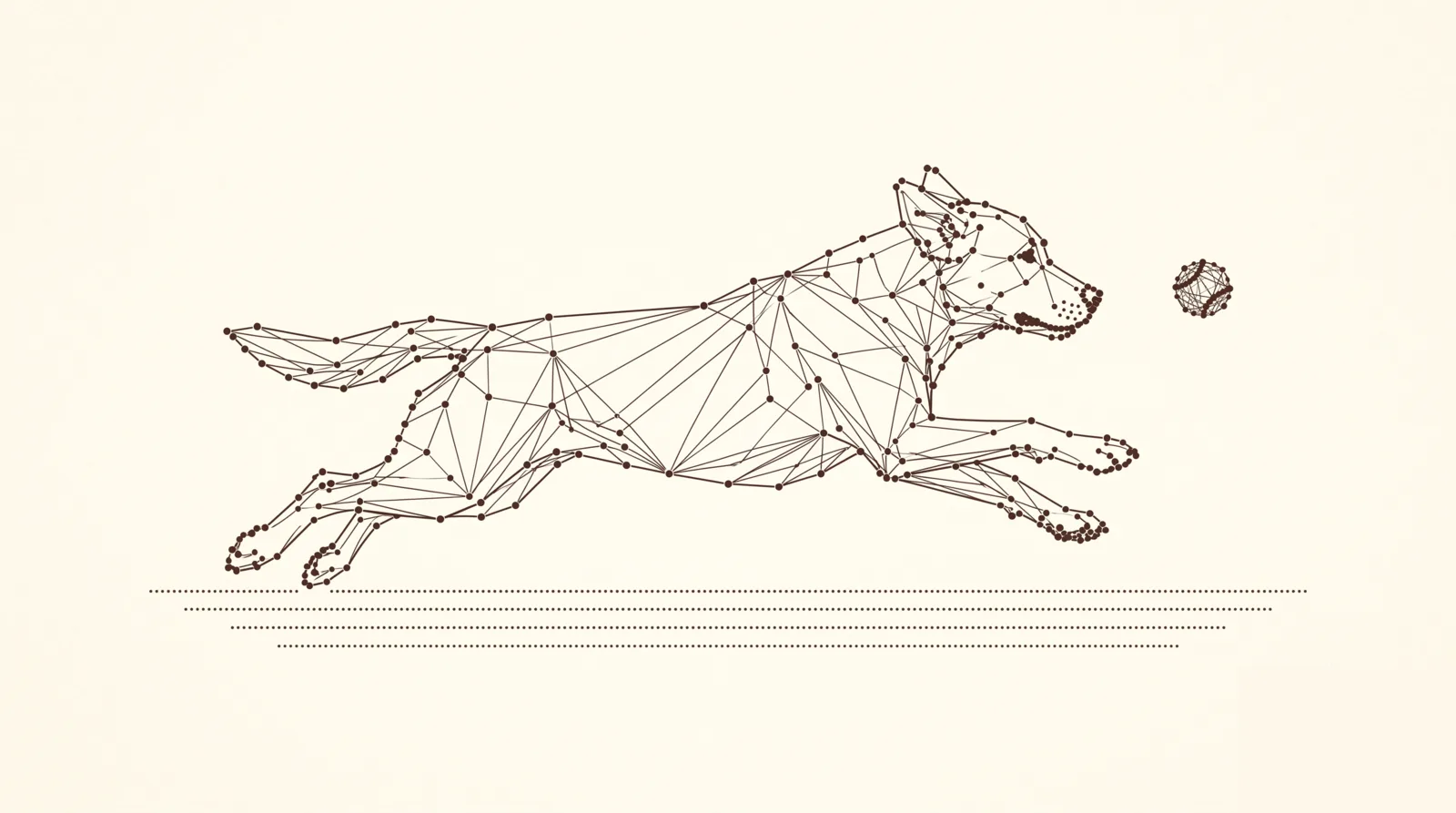
I should be honest about the other side, because autonomy cuts both ways. Sometimes the same tool marches off down a completely wrong path with the confidence of a labrador chasing a ball into a lake. And even when the output looks useful, I would be lying if I said you can just use it as-is. In practice you often spend as much time, or more, reading through, analyzing, and understanding the files it created as you would have spent building them yourself.
And it is not only the AI that can miss the track. Generating code and text is cheap and easy now, so you can lose control too. You stop moving toward the goal and start chasing the ball yourself: creating more files, editing a never-ending repo, just “adding one more feature”, mistaking motion for progress. The labrador is not always on the other side of the screen.
A workflow fails predictably: the path breaks, someone gets paged, you fix the path. An agent fails creatively: it invents a path you never anticipated. Sometimes so do you. That is not a reason to avoid agents. It is the reason knowing which one you have actually matters.
There is a quieter upside too. Working this way teaches you a lot about what agents can and cannot do. Shaping one until it works the way you want is not just a fun challenge anymore. It is becoming a real skill.
Why the label on the box matters
You might reasonably ask: who cares what we call it, as long as it works?
Here is why I care, and why it might matter to you too. Autonomy is simultaneously the thing you are paying for and the thing you have to manage. Get the label wrong in either direction and it costs you.
Buy a “revolutionary AI agent” that is really a workflow, and you have overpaid for a script with a chatbot’s face. Annoying, but survivable.
The reverse is worse. Deploy a real agent while believing it’s a predictable workflow, and you have handed runtime decision-making to a system nobody is supervising, because everyone assumed the path was fixed. The whole point of an agent is that the path is not fixed.
This is why “agent washing” has stopped being a nerd’s pedantic complaint. Lawyers at Debevoise & Plimpton have already argued, in a Harvard Law Forum piece, that overstating a product’s autonomy is the kind of measurable claim regulators and investors can test. When the lawyers start writing about your buzzword, the hype cycle has reached its final form.
And to be fair to the workflows: most business problems should be workflows. Predictable, auditable, boring. Boring is a feature when it’s your invoicing. You probably need an agent for far fewer things than the sales deck suggests. The problem was never that workflows are bad. The problem is selling one machine wearing the other one’s costume.
The test is yours to keep
Next time someone says “agent” (a vendor, a colleague, a LinkedIn post), ask the one question: who decides the next step?
If the answer is “a human did, in advance,” you are looking at a workflow. Possibly a great one. If the answer is “the AI does, as it goes,” you are looking at an agent, and the follow-up question is who is watching it.
And if the answer is a fifteen-minute explanation that never quite lands: well, now you know that about 130 out of several thousand vendors could answer it cleanly, and you have just learned which group this one belongs to.
My slightly uncomfortable take: most companies proudly deploying “agents” today are running workflows, and that is fine. They just shouldn’t be billed for autonomy they’re not getting. The real question underneath is quieter: in your own work, would you actually want the AI to decide the next step? Or is the predictable flowchart exactly the amount of AI you’re comfortable with?