
The climber and the transmission
The difference comes down to the environment around the model.
A wrapper sits entirely on the outside. It takes your prompt, polishes the wording behind the scenes, sends it through the API, and renders the reply in a clean layout. It changes how the user talks to the AI.
A harness changes how the AI talks to the world. It connects the model to tools, local files, sandboxes, and verification loops.
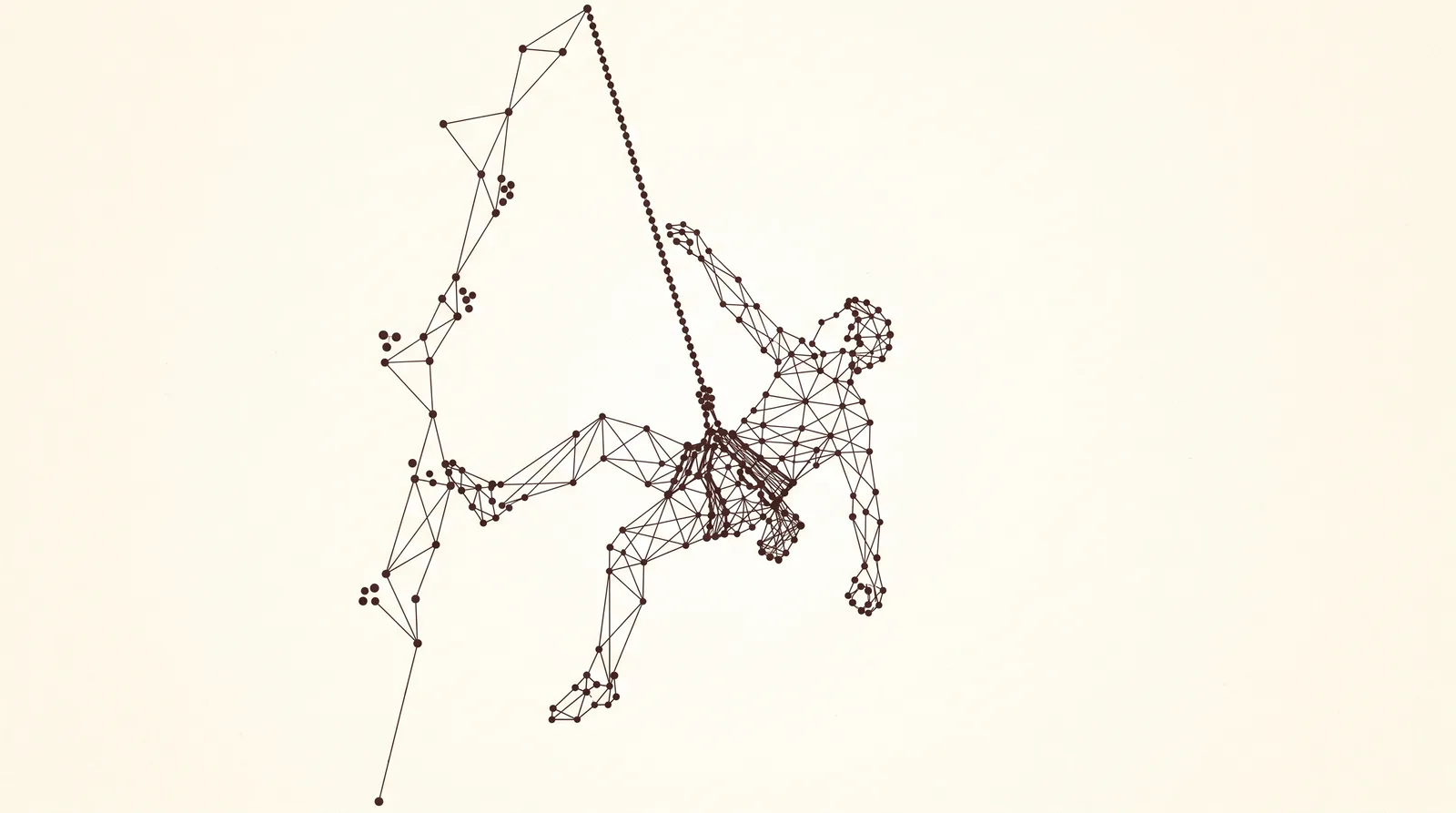
Think of a rock climber. When a climber slips on a difficult route, the harness does not make their fingers stronger or make the rock face any easier. It simply catches them when they fall, so a single slip does not end the climb. It turns a fatal fall into a temporary pause, lets them shake out their arms, and gives them another attempt at the same hold.
A raw model in a text box has no harness. One slip, and the entire output crashes.
Or if you prefer machinery: if a wrapper is a coat of paint on an engine, the harness is the transmission, the brakes, and the steering rack. It turns raw horsepower into controlled movement.
The single-breath problem
When you talk to a raw model in a web chat, you are asking it to solve a problem in one continuous breath. It generates token by token. It cannot stop halfway through a sentence, scratch its head, realize it made a calculation error three lines earlier, delete the paragraph, and start over.
If humans had to write code or draft legal contracts in one single stroke without backspacing or testing, our success rate would be terrible too. The miracle is not that naked models fail at 70% of hard tasks. The miracle is that they solve 30% without being allowed to look at what they just typed.
A harness fixes this by breaking the work into stages. Before generation, it guides the model: loads the relevant files, injects formatting rules, and blocks off irrelevant folders. After generation, it places sensors around the output: runs the script, executes the unit tests, or validates data in an isolated sandbox.
When something throws an error, you never see the breakdown. The harness grabs the error log, hands it back to the model, and says: “Line 42 threw a syntax error. Fix it.” The model gets to fail in private four times so it can succeed in public once.
The 30% to 100% scoreboard
Last week I wrote about how benchmark numbers on launch slides can be misleading, and how “smarter” often just means a lab let their model burn a deeper vault of tokens in private. But recent research from NVIDIA points to an even bigger blind spot on that scoreboard.
They took a frontier model and ran it through a notoriously difficult reasoning test. On its own, raw in the text box, it scored around 30%.
Then they put the exact same model inside an execution harness. They gave it a Python scratchpad, the ability to run its code, an error reader, and permission to retry up to five times. Without retraining the model, the success rate jumped from 30% to 100%.
They did not make the AI smarter. They just gave it the scaffolding to verify its own work.
In a follow-up study, they showed the same harness could cut token usage in half while still beating the benchmark scores of other agent setups. The reason is straightforward: without a harness, a model that hits a dead end keeps generating and burning tokens until it times out. A harness catches the failure early, stops the bleeding, and feeds the error back to the model instead of letting it spiral.
The flashlight test
A mediocre model in a great harness will consistently beat a genius model in a bare wrapper.
This is why thin AI products live in constant danger. If your product is just a nice form on top of an API, you are one model update away from disappearing. The moment the lab adds that button to their default web interface, the product has no reason to exist.
The tools that actually stick will not be the ones with the prettiest forms. They will be the ones that embed into a messy workflow, inspect the real environment, and quietly handle the retries when things go wrong.
We are moving past the phase where progress comes purely from waiting for the next frontier model to drop. Today’s models are already capable enough to do serious work, provided we stop asking them to do it naked in a text box. The question for anyone paying for AI software is no longer which model is running in the background. It is what happens between the moment the model generates an answer and the moment it lands on your screen.
Lately I have started looking at my own software subscriptions through that lens. Which tools are running real scaffolding and self-correction behind the scenes, and which ones are just flashlight apps waiting for Apple to add a toggle?